AI coding training for engineering, product and design
Engineering, product and design already share one requirement and one review. We teach them in the same room, on the same brief, because a workflow that only the engineers can run is not a team workflow. This is the training we run. The levels behind it are in AI coding maturity levels. The method is Delegate, Review, Own.
Put the three roles in one room
A mixed group is the useful shape. Engineers can produce a diff. Product and design can say whether that diff is the requirement. When they train apart, the engineers leave with a private habit and the rest of the team still writes tickets the agent cannot finish.
The same engagement is for all three roles. It is not a tool demo for one licence, and it is not a separate course per job title. The exercises run in the team's repository, with tools the team has already approved. The session is under NDA. Code and data stay in the team's systems.
A standard workshop is two days. A narrower scope can be one day. A group is ten to thirty people, with a minimum of eight. Fewer than eight people can join a cohort. Larger organisations train in successive groups of up to thirty. Delivery is onsite, at your offices, offsite at an external venue, or remote via Zoom.
Rolling this out in your team?
We train engineering teams on their own codebase in two days. Agent setup, shared rules and review included.
Score the room before the dates
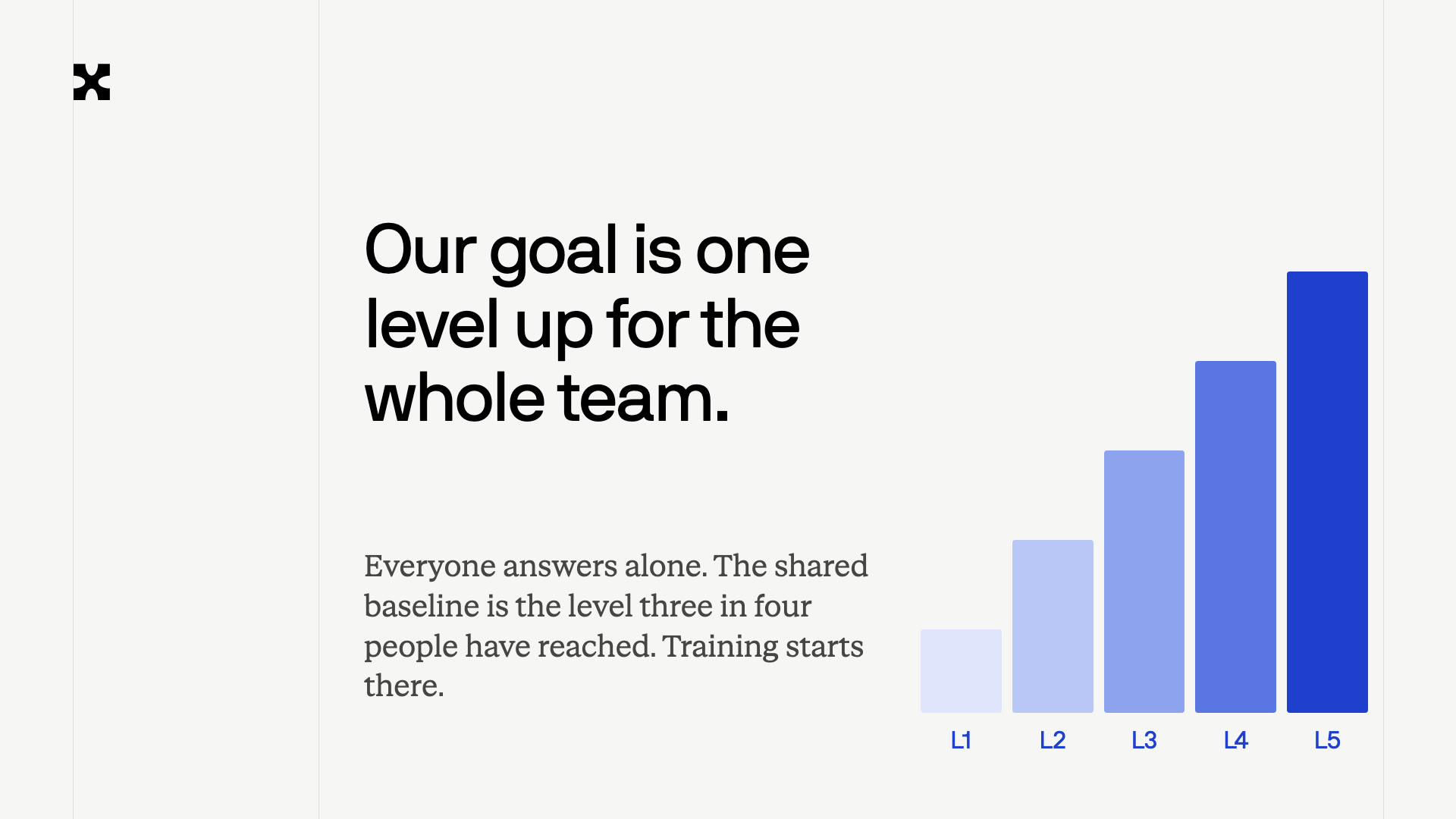
Before the dates are set, each person completes the team proficiency matrix alone. Engineers answer 16 questions. Product and design answer 12. A person's level is the average of their answers. The baseline for the group is the level three in four people have reached. Training starts there, then aims one level up, so the room is working on the same step.
The five levels are the ones published on the matrix:
- Assisted means AI helps one person.
- Delegated means an agent does a whole task and a person reviews every change.
- Systematic means one shared workflow in the repository.
- Governed means controls decide.
- Self-improving means the system adapts.
We do not start a mixed room at the top of that list because one person is already there. The baseline is the level most of the room has reached. The day is built to move that baseline one step, with a shared language for the requirement, the boundary and the review.
Practise one brief from three seats
The exercise is one brief, not three parallel courses.
Engineers practise a small change on the real repository: a clear brief, the context the agent needs, a diff a reviewer can explain, and a check against the tests and the team rules. They stop when the diff is something a colleague can review in one sitting. A vague request to improve a whole area is a failed brief, even if the agent produced a lot of code.
Product and design practise the same brief from their side. They name the requirement, the boundary, and the evidence that would show the change is done. They sit in the review so the acceptance criteria exist before the diff does. A requirement that arrives after the pull request is a review of a surprise. A requirement that arrives as the brief is a review of a decision.
The three seats meet on the pull request. The engineer can point at the lines. Product can say whether those lines are the requirement. Design can say whether the change matches the boundary they named. The agent does not settle that argument. A person does.
Follow the published engagement order
An engagement still starts in a fixed order. We do not skip to the calendar.
- A 30-minute introductory call.
- The team proficiency matrix, completed alone.
- A stakeholder call with the owners of requirements and review.
- A written proposal.
- Acceptance and scheduling.
- Bespoke training on your codebase.
The proposal confirms the scope, the schedule and the price. Travel and venue are quoted separately. The first month of Pulse is included with a workshop. Pulse is a shared Slack or Teams channel with both founders, a first response within two business days, a written briefing every two weeks, and a two-hour live session each month for up to ten engineers. Each briefing item carries one recommendation: adopt, test or ignore. Pulse has a three-month minimum and is then monthly. If the first session does not produce three changes the team will adopt, that month is refunded.
That month is how a mixed room keeps the brief after the two days. The engineers, the product manager and the designer are still in one channel, looking at the same pull requests.
Keep the habit after the two days
The two days are not the workflow. The workflow is what the repository still says on the following Monday. Write the agreement where the agent will read it: which work may be delegated, what evidence must come back, and who owns the merge. AGENTS.md or a short project instruction file is enough when people will maintain it.
Use one standard for Claude Code, Cursor and Codex. The tools differ in where the agent runs. The team rule is the same, including for the product and design people who do not live in the editor. They still name the requirement and sit in the review. Shared standards is that rollout. How to review AI-generated code is the review order the engineers practise in the room.
Measure the room before you scale the habit. The matrix is the before. The pull requests after the workshop are the after. We do not commit to a fixed productivity percentage. The record is whether the mixed group can run one brief, from requirement to reviewed change, without a private chat only one role can see.
Frequently asked questions
Who is in the room?
Engineers, product managers and designers. They already share the requirement and the review, so the useful group is mixed.
How is the starting level chosen?
Each person completes the team proficiency matrix alone. Engineers answer 16 questions. Product and design answer 12. The baseline is the level three in four people have reached. Training aims one level up from there.
How long is the workshop?
A standard workshop is two days. A narrower scope can be one day. A group is ten to thirty people, with a minimum of eight. Delivery is onsite, offsite, or remote via Zoom.
Book a 30-minute call when you want dates and a scope.
Related research
Train your team on coding agents
Two days on your team's own repository, onsite or remote, with a written proposal before you commit.
Book a callPrefer to measure first? Take the free team check.